How to Make Money From Building Apps in 2026: 10 Proven Ways (Step-by-Step Guide)
How to make money from building apps in 2026: 10 revenue models, income examples, app store fees, and a step-by-step plan to your first $1,000.
- Written by
- Nbark Kazdabi | Xray 0xFF
- Published
- Reading time
- 13 min
On this page
- The Short Answer: How Do You Make Money Building Apps?
- Can You Still Make Money Building Apps in 2026?
- How Do Apps Make Money? 10 Revenue Models Compared
- How Much Money Can You Make From an App?
- How to Build an App and Make Money: 7 Steps
- App Store Fees in 2026: What Apple and Google Take
- App Ideas That Make Money in 2026
- How to Make Money Building Apps Without Coding
- How to Get Your First Paying Users
- Common Mistakes That Kill App Revenue
- Is Making Money From Apps Passive Income?
- A Realistic Plan to Reach Your First $1,000 a Month
- Frequently Asked Questions
- Final Thoughts
- Sources
How to Make Money From Building Apps in 2026: 10 Proven Ways (Step-by-Step Guide)
By Xray AI Lab · Updated November 7, 2026
The Short Answer: How Do You Make Money Building Apps?
There are two main paths:
- Own the app and charge for it. You earn from subscriptions, in-app purchases, ads, marketplace commissions, affiliate links, or sponsorships.
- Build apps for other people. You earn from freelance projects, white-label apps, or by selling one niche app template to many clients.
The second path usually pays sooner, because clients pay before launch. The first pays more over time if the app finds an audience. Many builders do both: client work for cash flow, and their own app on the side.
Can You Still Make Money Building Apps in 2026?
Yes, and the opportunity is moving toward utility apps. Sensor Tower’s State of Mobile 2026 report found that consumers spent about $85.6 billion in non-game apps in 2025, up 21%, versus $81.8 billion in games, up only 1%. It was the first year non-game apps out-earned games. Total in-app purchase spending reached about $167 billion, with AI assistants, social, streaming, and productivity apps driving the growth.
The catch is competition. RevenueCat’s State of Subscription Apps 2026 report, based on more than 115,000 apps and $16 billion in revenue, found that monthly new subscription app launches grew from about 2,000 in January 2022 to more than 14,700 in January 2026. Yet apps launched before 2020 still earn about 69% of all subscription revenue.
The lesson: do not try to beat the giants. Pick a niche, solve one problem well, and charge people who already feel that problem.
How Do Apps Make Money? 10 Revenue Models Compared
| Revenue model | Best for | Main risk |
|---|---|---|
| Subscription | Daily-use tools, fitness, learning, productivity | Churn if value fades |
| Hard paywall | Apps with an instant, clear benefit | Users never try it |
| Freemium | Apps needing a big audience first | Free users cost money |
| In-app purchases | Games, creative tools, credits | Feels pushy if overdone |
| Paid download | Niche, high-value tools | Limits reach |
| In-app ads | High-traffic casual apps | Needs huge volume |
| Usage-based or AI credits | AI apps with real compute cost | Bill shock |
| Marketplace commission | Apps connecting buyers and sellers | Needs both sides |
| Affiliate and sponsorships | Focused niche audiences | Unpredictable income |
| B2B licensing and client work | Builders who sell to businesses | Time-for-money trade |
1. Subscriptions
Users pay weekly, monthly, or yearly. This is the default model for indie apps because revenue compounds and is predictable. It works when users would miss the app if it disappeared. Offer an annual plan prominently, since annual subscribers usually churn less.
2. Hard paywall vs freemium
A hard paywall asks users to start a trial or subscribe before using the core app. Freemium gives a free tier and locks premium features. RevenueCat’s 2026 data shows hard-paywall apps convert about 10.7% of downloads to paid within 35 days, versus about 2.1% for freemium, and earn about $3.09 per install at day 60 versus $0.38. But 12-month retention is nearly identical (27% vs 28%). Freemium still makes sense for social or community apps where value takes weeks to appear.
3. In-app purchases
Users buy features, content, or virtual goods inside a free app. Consumables, such as credits or coins, are bought again and again. Non-consumables, such as removing ads, are bought once. This model fits apps with a natural moment where extra capability adds value.
4. Paid downloads
Users pay once to download. It is simple, but it caps your income at one sale per user and limits reach. It works best for niche professional tools where the buyer knows exactly why they need it.
5. In-app advertising
You earn per impression, click, or completed view. Rewarded video usually pays best and banners the least. Fora Soft estimates most apps earn roughly $0.01 to $0.10 per monthly active user per month from ads, so ads only work with large daily traffic. Opt-in ads, such as watching a video for a hint, perform better than interruptions.
6. Usage-based and AI pricing
If your app runs AI features, every request costs you money. A flat unlimited plan can let heavy users erase your margin. Tiered plans with credits or usage caps protect profit better. Appinventiv, summarizing RevenueCat data, reports AI apps earn more per paying user ($30.16 vs $21.37 in year one) but keep fewer annual subscribers (21.1% vs 30.7%), so retention matters even more for AI apps.
7. Marketplace commission
You connect buyers and sellers and take a cut of each transaction. It needs supply and demand together. Recruit sellers by hand first, then go after buyers.
8. Affiliate and referral income
You earn a commission when users buy through your links. It works as a second income stream when the recommendation fits naturally, such as a budgeting app recommending a savings account. It fails when it feels like hidden advertising.
9. Sponsorships and partnerships
A brand pays for visibility inside a focused, engaged audience. Sponsors pay for fit and engagement, not raw user count, so a small niche app can beat a bigger generic one.
10. Client work, white-label apps, and selling apps
You can also earn without waiting for downloads. Freelancers build apps for local businesses, resell one niche template to many clients, or sell finished apps. BuildFire notes that reselling one niche app to many clients pays best per hour of effort once the template exists, and none of these routes require you to be a developer.
How Much Money Can You Make From an App?
The honest answer is anywhere from $0 to millions, and most apps land at the low end. Fora Soft puts the median app under $1,000 a month. Your income depends on one formula:
App revenue = users × share who pay × price × (1 minus store fee)
Here are worked examples you can adjust:
| Scenario | Math | Monthly result |
|---|---|---|
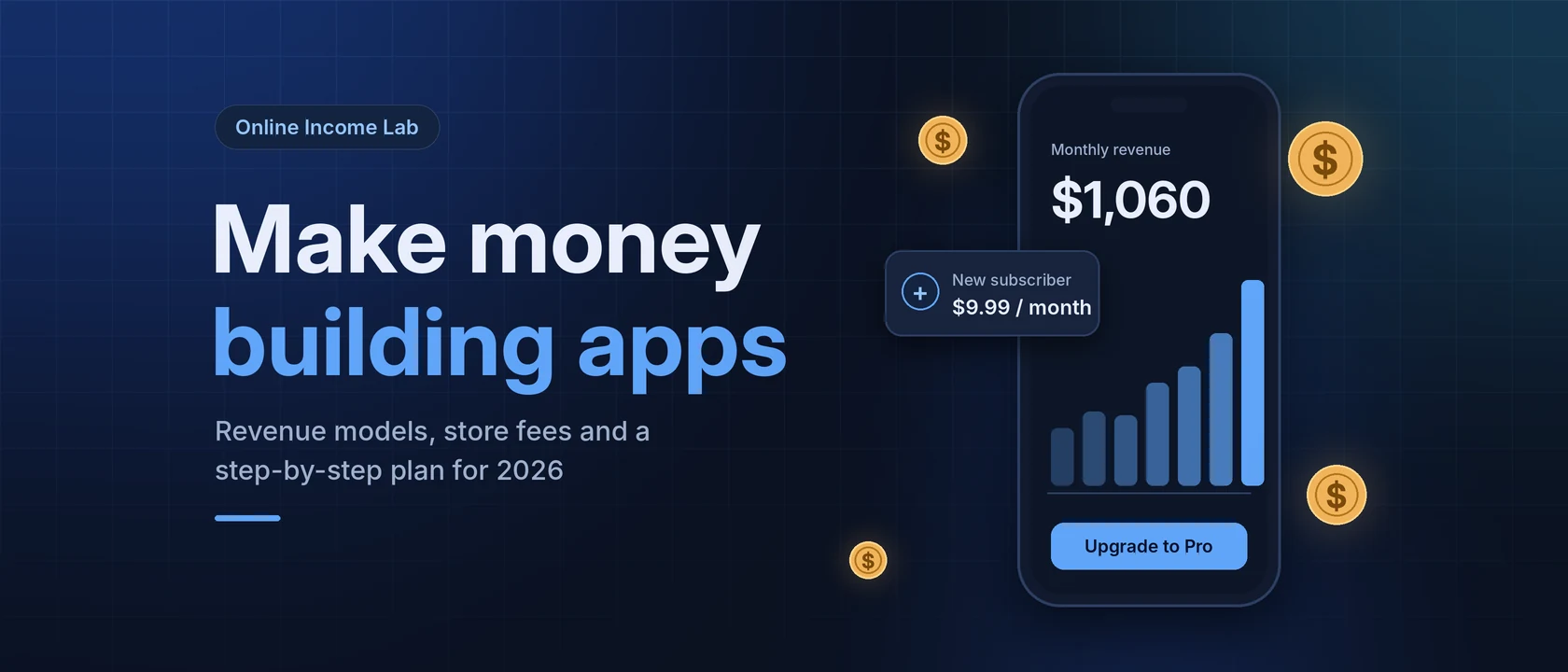
| Niche subscription app | 125 subscribers × $8.49 net ($9.99 minus a 15% fee) | About $1,060 |
| iOS app, 10,000 downloads | 2.6% convert × $5 plan × 85% | About $1,100 |
| Ad-supported app | 100,000 monthly active users × $0.01 to $0.10 | $1,000 to $10,000 |
These are illustrations, not promises. The 2.6% figure is RevenueCat’s median day-35 download-to-paid conversion on iOS; Android is lower, at about 0.9%.
Founders report real results from small apps. Solo developers have publicly shared a habit-tracker reaching about $13,600 in monthly recurring revenue and an open-source social media scheduler growing from $2,100 to $14,200 a month. Treat these as founder-reported, but they show what a focused niche can do.
How to Build an App and Make Money: 7 Steps
Step 1: Pick a problem people already pay to solve
The best ideas save time, save or make money, or remove a daily frustration. Search app stores and Reddit for complaints about existing apps, and look for people paying for a clumsy workaround such as a spreadsheet or a freelancer. Pick a niche where one developer can win, and avoid categories that need network effects, like social media or ride-sharing.
Step 2: Choose how you will build it
You have three options, and none requires years of study:
- AI app builders (vibe coding). Describe the app in plain language and the tool generates the screens, login, database, and payments. Examples include Base44 and Emergent. Fastest for testing an idea.
- No-code platforms. Visual builders such as Adalo or Bubble give more control over layout and logic without writing code.
- Traditional code. Flutter, React Native, Swift, or Kotlin. Best when you need performance or deep device features, but slower and more expensive.
Because building is now cheap, spend your savings on testing demand, not on polishing features.
Step 3: Build only the core feature
Ship the one feature that solves the problem. Add nice-to-haves in later updates. A small app that never crashes beats a large one that sometimes does.
Step 4: Add payments from day one
A backend that handles billing early lets you test real willingness to pay. RevenueCat is widely used to manage in-app subscriptions and paywalls, and Stripe handles web payments. Decide your model before launch, not after.
Step 5: Price with store fees in mind
Fees come out of every sale, so calculate profit per user, not just revenue. The next section shows what Apple and Google take in 2026.
Step 6: Launch where your users are
Publish on the Apple App Store, Google Play, or both. Many indie builders start on iOS, where conversion tends to be higher, then add Android. A web app is also a valid first launch because it skips store fees entirely.
Step 7: Measure, test, and improve
Track download-to-trial and trial-to-paid conversion, retention at day 1, 7, and 30, churn on monthly versus annual plans, and revenue per install. Treat pricing and paywall design as experiments. Small tests compound.
App Store Fees in 2026: What Apple and Google Take
Platform rules changed a lot in 2026, so check the current terms before you price. Here is the summary as of November 2026.
| Platform | Standard cut | Small-developer or subscription rate | Developer account |
|---|---|---|---|
| Apple App Store | 30% | 15% under $1M yearly proceeds if you enroll in the Small Business Program; subscriptions drop to 15% after a subscriber’s first paid year | $99 per year |
| Google Play (US, UK, EEA) | 20% to 25% on in-app purchases above $1M | 10% on the first $1M and 10% on auto-renewing subscriptions, plus a 5% billing fee if you use Google Play Billing | $25 one time |
| Google Play (other regions) | Rolling out region by region through 2027 | Older 15% and 30% tiers may still apply | $25 one time |
Three practical points:
- Apple’s Small Business Program is not automatic. You must enroll in App Store Connect, and it applies only if your proceeds were under $1 million the previous year.
- Google’s 10% subscription fee is closer to 15% in practice. Add the 5% billing fee when you use Play Billing, which most apps do.
- External payment links are changing. In the US, apps can link to outside web checkout, and Apple has so far collected no commission on those purchases while courts decide a reasonable rate. You must still offer in-app purchase alongside. Google says US developers using alternative billing must report transactions and pay fees from October 1, 2026. These rules are still moving, so verify before relying on them.
Example: a $9.99 plan with a 15% fee leaves you about $8.49 before payment processing, hosting, AI costs, and support.
App Ideas That Make Money in 2026
Profitable ideas share three traits: proven demand, subscription potential, and a scope one person can maintain. Categories with real revenue:
- Health, fitness, and habit tracking. Recurring use and a clear reason to pay monthly.
- Personal finance and budgeting. An app that helps someone cancel $50 a month in unused subscriptions makes $5 a month feel cheap.
- Productivity and utilities. Calendar, notes, focus, and scheduling tools with a sharp niche.
- AI micro-tools. Headshots, resumes, writing helpers, and chatbots for one industry. Charge by credits to cover compute cost.
- Education and language learning. Strong retention when progress is visible.
- B2B niche tools. Invoicing, follow-ups, and onboarding for a specific profession. Businesses pay more and churn less.
The rule that works: pair your own expertise with an underserved niche where people already spend money on bad workarounds.
How to Make Money Building Apps Without Coding
Yes, you can earn without writing code. Describe your app to an AI builder, test it with real users, and charge from the first version. Freelancers also sell AI-built apps and websites to local businesses such as restaurants, salons, and clinics. The skill that earns money is not syntax. It is choosing the right problem, running a clear offer, and being reliable.
Set one expectation: the code is rarely the hard part. As one founder in a Product Hunt discussion put it, vibe coding shifts the focus from how to build to what to build.
How to Get Your First Paying Users
Nobody pays for an app they cannot find. Start with these:
- App Store Optimization (ASO). Put your main keyword in the title and subtitle, write a clear description, and show results in your screenshots.
- Communities. Share the app where your users already gather: subreddits, Discord servers, Facebook groups, and niche forums.
- Short videos. A 30-second clip showing the problem and the fix is the cheapest marketing available.
- A landing page and waitlist. Collect emails before launch so day one has users.
- Fair local pricing. One solo developer reported lifting growth by adding purchasing-power pricing for different countries.
Common Mistakes That Kill App Revenue
- Building before validating. Talk to ten potential users first.
- Adding payments too late. Free-only launches teach you nothing about willingness to pay.
- Ignoring costs. Hosting, AI usage, and store fees can erase revenue.
- Relying on ads with low traffic. Ads need scale.
- Charging too little. Low prices need huge volume; niche apps can charge more.
- Skipping retention. Acquiring users you cannot keep is an expensive leak.
- Over-building. More features rarely fix a weak idea.
Is Making Money From Apps Passive Income?
Mostly no. An app can earn while you sleep, but it still needs updates, support, bug fixes, and marketing. Treat it as a small business with low ongoing hours, not a machine that runs itself. That is still attractive: you build once and serve many users at little extra cost.
A Realistic Plan to Reach Your First $1,000 a Month
- Weeks 1 to 2: choose one specific problem and interview ten users.
- Weeks 3 to 4: build the core feature with an AI builder or no-code tool, with a paywall included.
- Month 2: launch to one community, collect feedback, fix the biggest friction.
- Month 3: test price, trial length, and paywall wording, and add an annual plan.
- Month 4 onward: double down on the single channel that works.
At about $8.50 net per subscriber, roughly 120 paying users reach $1,000 a month. One solo developer reported reaching $1,000 in monthly recurring revenue in 8 months with no development budget, so give it time.
Frequently Asked Questions
How do you make money building apps? Charge users through subscriptions or in-app purchases, show ads, take marketplace commissions, earn affiliate or sponsor income, or get paid to build apps for clients.
How much money can you make from an app? From nothing to millions. The median app earns under $1,000 a month, while a focused niche app can reach a few thousand dollars a month. Revenue depends on users, conversion, price, and retention.
Can you make money from an app without coding? Yes. AI app builders and no-code platforms let non-developers build and launch apps, and you can earn by charging subscriptions or by selling apps to businesses.
Do free apps make money? Yes. They earn from ads, in-app purchases, premium tiers, affiliate links, and sponsorships.
What is the most profitable app model? Subscriptions earn the most for apps with strong retention. Hard paywalls convert about five times better than freemium in RevenueCat’s data, but freemium can suit social or slow-to-explain apps.
Which pays better, iOS or Android? Per RevenueCat, iOS converts better: about 2.6% of downloads become paying users within 35 days, versus about 0.9% on Android. Many indie builders launch on iOS first.
How long does it take for an app to make money? You can earn your first dollar within weeks if payments are built in. Reaching $1,000 a month commonly takes several months.
How much does it cost to build an app? Agency quotes for a basic app often start around $16,000 to $30,000. With AI app builders or no-code tools, a first version can cost a monthly subscription plus your time, and Apple’s $99 a year and Google’s $25 one-time fees.
Final Thoughts
Making money building apps comes down to one question: does your chosen model earn more than it costs to run? Start with a real problem, build the smallest useful version, price with store fees in mind, and measure everything. The builders who win in 2026 are not the ones who write the most code. They find a real need and test their way to a model that pays.
Want more practical guides on AI tools, app building, and earning online? Follow Xray AI Lab.
Sources
- Sensor Tower: State of Mobile 2026 and the consumer spending breakdown
- RevenueCat: State of Subscription Apps 2026 and the Android paywall gap analysis
- Android Developers Blog: Expanded billing choice and lower fees on Google Play
- RevenueCat: App Store fees and Apple Small Business Program overview
- Fora Soft: How much can an app make
- Appinventiv: How do apps make money
- BuildFire: How to sell mobile apps
- MacDailyNews: Apple external link commission update
- Anything: solo founder app revenue examples